 70 Morley Cresent, Kelloe, Durham DH64NS
Resin Paths Around Existing Gardens: How to Plan Without Disrupting Borders
Plan a resin path around existing garden borders with practical tips to protect planting areas, manage access and achieve a clean finish.

Why you can trust our content
At a glance
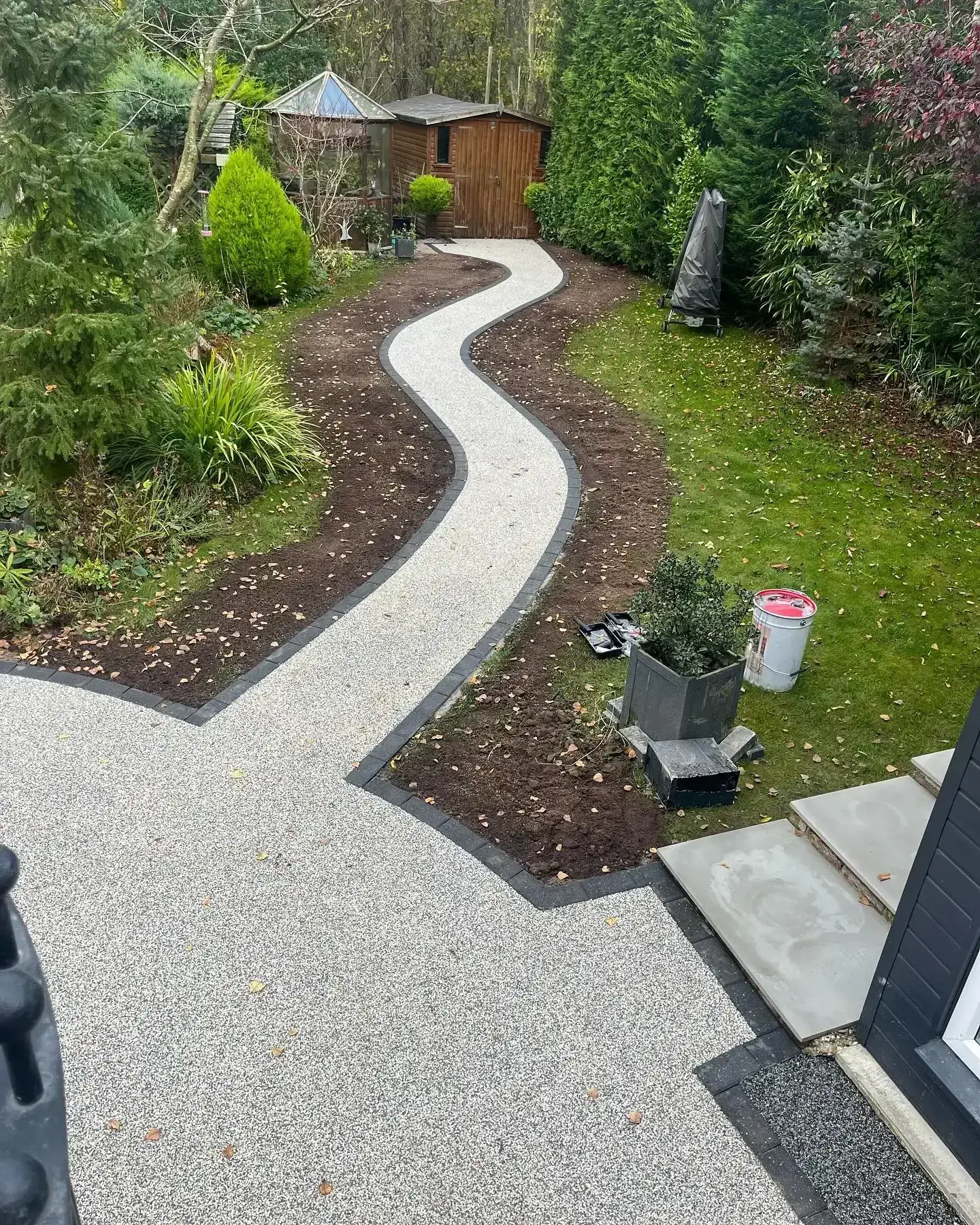
Garden paths often have to work around established planting, raised beds, lawns and carefully maintained borders. Replacing an old path can therefore require more thought than simply choosing a new surface.
Resin paths can provide a clean, practical route through a garden while fitting around existing landscaping. However, the quality of the finished result depends heavily on how the path is planned, prepared and edged.
For homeowners considering a new path, protecting established borders should be part of the plan from the beginning. The aim is not simply to install a durable surface, but to create a route that works naturally with the garden already in place.
How should a resin path be planned around an existing garden?
The best starting point is the existing layout rather than the surface material.
Walk the route you currently use and consider whether it is wide enough, whether the alignment makes sense and whether there are areas where water collects. Look at how the proposed path connects to doors, gates, patios and other parts of the garden.
A useful planning exercise should consider:
- The current path and its condition
- Garden borders and planting
- Trees and established shrubs
- Lawns and other groundcover
- Steps and changes in level
- Drainage
- Gateways and entrances
- Width of the proposed route
- Edging requirements
This helps create a path that looks integrated rather than appearing to have been added after the garden was designed.
Can resin paths be installed without damaging garden borders?
Yes, but careful preparation is important.
Existing borders should be identified before excavation or groundwork begins. The installation team needs to understand exactly where the finished path will run and where the garden needs to remain undisturbed.
Edging can be particularly useful because it creates a defined boundary between the path and planting areas. A suitable edge can help keep the finished surface contained while giving the garden a neat transition.
Where plants grow close to the proposed route, it may also be necessary to consider their root systems and the amount of excavation required. Large established trees deserve particular attention because extensive roots can affect both construction and future surface performance.
The exact approach will depend on the garden and the proposed path layout.
What should happen to plants close to the path?
Not every plant needs to be removed, but planting close to a new path needs to be assessed.
Overhanging shrubs can make a path feel narrower, while aggressive roots may affect the underlying ground. Some plants may also spread across the finished surface over time.
Before installation, identify:
- Plants growing directly beside the proposed route
- Large shrubs that may need pruning
- Trees with visible or extensive roots
- Plants that spread rapidly
- Borders that need temporary protection
- Irrigation or garden services beneath the proposed path
Protective measures can be discussed during the site survey. In some cases, small changes to the route may help preserve valuable planting while still creating a practical walkway.
Choose your preferred outdoor space finish?

Resin

Tarmac
It just takes 2 minutes
And then you can book a free consultation
How wide should a garden path be?
There is no universal width that works for every garden.
A narrow decorative path may be suitable for walking between planting areas, while a main route to a rear entrance may need additional space. If two people regularly need to pass each other, a wider route will usually be more comfortable.
Think about how the path will actually be used.
For example:
| Path use | Planning consideration |
| Access to a shed | Allow comfortable movement and carrying items |
| Main garden route | Consider regular two-way use |
| Wheelbarrow access | Allow enough clearance for equipment |
| Route to a patio | Create a practical connection |
| Narrow border path | Keep the layout proportional to the garden |
| Side passage | Check width, gates and drainage carefully |
The path should look balanced in relation to the garden rather than simply being as wide as the available space allows.
How should drainage be planned around garden borders?
Drainage should be considered before the finished surface is installed.
A new path can alter the way rainwater moves through a garden, particularly where it replaces soil, paving or another existing surface. If the path is laid on a gradient, water may naturally travel towards a border.
A suitable construction can help manage rainfall, but the overall design still needs to account for levels, surrounding ground and existing drainage.
During planning, consider:
- Where water currently flows
- Whether the garden has naturally low areas
- Whether the path crosses a slope
- Where the path meets a patio or driveway
- Whether existing drains are nearby
- Whether edging could affect water movement
Addressing these issues during the survey is much easier than attempting to correct drainage after the surface has been installed.
If you are planning a garden path around established landscaping, North East Surfacing can assess the route, surrounding ground and preparation requirements before work begins.
What type of edging works with garden paths?
Edging has both a practical and visual purpose.
It helps define the path and separates the finished surface from soil, grass or planting. Without a clear boundary, garden materials can gradually spread onto the path and make maintenance more difficult.
The best edging choice depends on the property’s existing materials and the style of the garden.
Options may include:
- Block or brick edging
- Concrete restraints
- Paving-style borders
- Other suitable fixed edging systems
A contrasting edge can create a more defined feature, while a subtle edge can allow the path to blend into the landscaping.
The important point is that edging should be planned before the main surface is installed so the finished levels and boundaries work together.
How can you protect an established garden during installation?
Good site preparation should take the surrounding garden into account.
Where practical, vulnerable plants and decorative features should be protected from construction activity. Clear access routes can also reduce the need for installers to move unnecessarily through planted areas.
You can help by:
- Marking areas that must remain untouched
- Moving portable garden furniture
- Identifying irrigation lines
- Pointing out hidden drainage features
- Pruning overhanging growth where appropriate
- Keeping pets away from the working area
- Discussing access before installation day
If you have particularly valuable or mature planting, mention it during the survey rather than assuming the installer will know which areas require special care.
How much does resin path installation cost?
The resin path installation cost depends on the individual project rather than simply the square metre area.
A short, straightforward path with easy access and a suitable base may require less preparation than a longer route that winds around established planting or crosses different levels.
Factors that can influence the overall cost include:
- Path dimensions
- Existing surface
- Ground preparation
- Excavation requirements
- Edging
- Drainage
- Access
- Waste removal
- Aggregate selection
- Complexity of the layout
This is why comparing a price based solely on the finished area can be misleading. Two paths with similar dimensions may have very different preparation requirements.
Is it possible to create curves around garden borders?
Curved paths can work particularly well in landscaped gardens because they can follow existing planting and create a softer transition between different areas.
However, curves need to be planned carefully. A path that is too narrow or has abrupt changes in direction may become awkward to use.
The layout should balance appearance with practicality. Consider where the path starts and ends, how people naturally move through the garden and whether the curve provides a useful route rather than simply adding visual interest.
A site survey can help establish whether the proposed shape can be constructed effectively within the available space.
If you have an established garden and want a path that works around existing borders, speak to North East Surfacing about the proposed layout and installation requirements.
What should you agree before installation starts?
Before committing to the work, make sure the scope is clear.
Discuss:
- The exact route of the path
- Finished width and levels
- Existing borders that need protecting
- Edging style
- Drainage arrangements
- Preparation and excavation
- Access requirements
- Aggregate colour and finish
- Waste removal
- Expected installation timescale
A written scope can be particularly useful where the path has an unusual shape or runs through an established garden.
Plan the path as part of the garden
A well-planned garden path should feel like a natural part of the landscape rather than a separate feature placed over it. Existing borders, trees, planting, drainage and access all need to be considered before the surface is installed.
For homeowners considering resin paths, careful planning can help protect established landscaping while creating a practical route through the garden.
North East Surfacing can assess the proposed path, surrounding areas and preparation requirements to help you understand what is involved. If you are considering a new garden path, contact the team to discuss the layout and arrange tailored advice.
Related articles
Choose your preferred outdoor space finish?
Resin
Tarmac
At a glance
Garden paths often have to work around established planting, raised beds, lawns and carefully maintained borders. Replacing an old path can therefore require more thought than simply choosing a new surface.
Resin paths can provide a clean, practical route through a garden while fitting around existing landscaping. However, the quality of the finished result depends heavily on how the path is planned, prepared and edged.
For homeowners considering a new path, protecting established borders should be part of the plan from the beginning. The aim is not simply to install a durable surface, but to create a route that works naturally with the garden already in place.
How should a resin path be planned around an existing garden?
The best starting point is the existing layout rather than the surface material.
Walk the route you currently use and consider whether it is wide enough, whether the alignment makes sense and whether there are areas where water collects. Look at how the proposed path connects to doors, gates, patios and other parts of the garden.
A useful planning exercise should consider:
- The current path and its condition
- Garden borders and planting
- Trees and established shrubs
- Lawns and other groundcover
- Steps and changes in level
- Drainage
- Gateways and entrances
- Width of the proposed route
- Edging requirements
This helps create a path that looks integrated rather than appearing to have been added after the garden was designed.
Can resin paths be installed without damaging garden borders?
Yes, but careful preparation is important.
Existing borders should be identified before excavation or groundwork begins. The installation team needs to understand exactly where the finished path will run and where the garden needs to remain undisturbed.
Edging can be particularly useful because it creates a defined boundary between the path and planting areas. A suitable edge can help keep the finished surface contained while giving the garden a neat transition.
Where plants grow close to the proposed route, it may also be necessary to consider their root systems and the amount of excavation required. Large established trees deserve particular attention because extensive roots can affect both construction and future surface performance.
The exact approach will depend on the garden and the proposed path layout.
What should happen to plants close to the path?
Not every plant needs to be removed, but planting close to a new path needs to be assessed.
Overhanging shrubs can make a path feel narrower, while aggressive roots may affect the underlying ground. Some plants may also spread across the finished surface over time.
Before installation, identify:
- Plants growing directly beside the proposed route
- Large shrubs that may need pruning
- Trees with visible or extensive roots
- Plants that spread rapidly
- Borders that need temporary protection
- Irrigation or garden services beneath the proposed path
Protective measures can be discussed during the site survey. In some cases, small changes to the route may help preserve valuable planting while still creating a practical walkway.
Choose your preferred outdoor space finish?
Resin
Tarmac
It just takes 2 minutes
And then you can book a free consultation
How wide should a garden path be?
There is no universal width that works for every garden.
A narrow decorative path may be suitable for walking between planting areas, while a main route to a rear entrance may need additional space. If two people regularly need to pass each other, a wider route will usually be more comfortable.
Think about how the path will actually be used.
For example:
| Path use | Planning consideration |
| Access to a shed | Allow comfortable movement and carrying items |
| Main garden route | Consider regular two-way use |
| Wheelbarrow access | Allow enough clearance for equipment |
| Route to a patio | Create a practical connection |
| Narrow border path | Keep the layout proportional to the garden |
| Side passage | Check width, gates and drainage carefully |
The path should look balanced in relation to the garden rather than simply being as wide as the available space allows.
How should drainage be planned around garden borders?
Drainage should be considered before the finished surface is installed.
A new path can alter the way rainwater moves through a garden, particularly where it replaces soil, paving or another existing surface. If the path is laid on a gradient, water may naturally travel towards a border.
A suitable construction can help manage rainfall, but the overall design still needs to account for levels, surrounding ground and existing drainage.
During planning, consider:
- Where water currently flows
- Whether the garden has naturally low areas
- Whether the path crosses a slope
- Where the path meets a patio or driveway
- Whether existing drains are nearby
- Whether edging could affect water movement
Addressing these issues during the survey is much easier than attempting to correct drainage after the surface has been installed.
If you are planning a garden path around established landscaping, North East Surfacing can assess the route, surrounding ground and preparation requirements before work begins.
What type of edging works with garden paths?
Edging has both a practical and visual purpose.
It helps define the path and separates the finished surface from soil, grass or planting. Without a clear boundary, garden materials can gradually spread onto the path and make maintenance more difficult.
The best edging choice depends on the property’s existing materials and the style of the garden.
Options may include:
- Block or brick edging
- Concrete restraints
- Paving-style borders
- Other suitable fixed edging systems
A contrasting edge can create a more defined feature, while a subtle edge can allow the path to blend into the landscaping.
The important point is that edging should be planned before the main surface is installed so the finished levels and boundaries work together.
How can you protect an established garden during installation?
Good site preparation should take the surrounding garden into account.
Where practical, vulnerable plants and decorative features should be protected from construction activity. Clear access routes can also reduce the need for installers to move unnecessarily through planted areas.
You can help by:
- Marking areas that must remain untouched
- Moving portable garden furniture
- Identifying irrigation lines
- Pointing out hidden drainage features
- Pruning overhanging growth where appropriate
- Keeping pets away from the working area
- Discussing access before installation day
If you have particularly valuable or mature planting, mention it during the survey rather than assuming the installer will know which areas require special care.
How much does resin path installation cost?
The resin path installation cost depends on the individual project rather than simply the square metre area.
A short, straightforward path with easy access and a suitable base may require less preparation than a longer route that winds around established planting or crosses different levels.
Factors that can influence the overall cost include:
- Path dimensions
- Existing surface
- Ground preparation
- Excavation requirements
- Edging
- Drainage
- Access
- Waste removal
- Aggregate selection
- Complexity of the layout
This is why comparing a price based solely on the finished area can be misleading. Two paths with similar dimensions may have very different preparation requirements.
Is it possible to create curves around garden borders?
Curved paths can work particularly well in landscaped gardens because they can follow existing planting and create a softer transition between different areas.
However, curves need to be planned carefully. A path that is too narrow or has abrupt changes in direction may become awkward to use.
The layout should balance appearance with practicality. Consider where the path starts and ends, how people naturally move through the garden and whether the curve provides a useful route rather than simply adding visual interest.
A site survey can help establish whether the proposed shape can be constructed effectively within the available space.
If you have an established garden and want a path that works around existing borders, speak to North East Surfacing about the proposed layout and installation requirements.
What should you agree before installation starts?
Before committing to the work, make sure the scope is clear.
Discuss:
- The exact route of the path
- Finished width and levels
- Existing borders that need protecting
- Edging style
- Drainage arrangements
- Preparation and excavation
- Access requirements
- Aggregate colour and finish
- Waste removal
- Expected installation timescale
A written scope can be particularly useful where the path has an unusual shape or runs through an established garden.
Plan the path as part of the garden
A well-planned garden path should feel like a natural part of the landscape rather than a separate feature placed over it. Existing borders, trees, planting, drainage and access all need to be considered before the surface is installed.
For homeowners considering resin paths, careful planning can help protect established landscaping while creating a practical route through the garden.
North East Surfacing can assess the proposed path, surrounding areas and preparation requirements to help you understand what is involved. If you are considering a new garden path, contact the team to discuss the layout and arrange tailored advice.
Related articles
Choose your preferred outdoor space finish?
Resin
Tarmac


